Showing posts with label book reviews. Show all posts

Wednesday, November 30, 2011

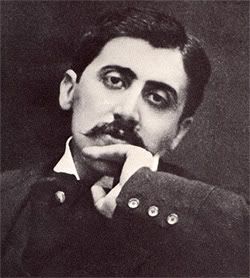
Proust on Sadism


I have spent the month of November -- which is National Novel Writing Month, after all! -- working on the novel I started this summer. It is set in the 1950s and 1960s, and it is about obscene literature and sadomasochism.

In the section I have been working on for the past week and a half, a character makes the argument that the pulp fiction of the '50s is nothing new, and that its writers are in fact part of a long literary tradition. I've been exploring this idea by tracking down works of literature that address this subject matter, and today I finally tracked down this quote from Marcel Proust. It appears on page 162 of the Gallimard edition of Swann's Way, as the young narrator spies on a lesbian couple having some kinky sex:

"Les sadiques de l'espèce de Mlle Vinteuil sont des êtres si purement sentimentaux, si naturellement vertueux que même le plaisir sensuel leur paraît quelque chose de mauvais, le privilège des méchants. Et quand ils se concèdent à eux-mêmes de s'y livrer un moment, c'est dans la peau des méchants qu'ils tâchent d'entrer leur complice, de façon à avoir eu un moment l'illusion de s'être évadé de leurs âmes scrupuleuses et tendres, dans le monde inhumain du plaisir."
TRANSLATION:
"Sadists like Mademoiselle Vinteuil are such purely romantic beings, so naturally virtuous, that even sensual pleasure to them seems like something evil, the privilege of the wicked. And when they allow themselves to give in to it for a moment, it is in the guise of evil that they try to dress their accomplice, so as to have, for a moment, the illusion of having escaped from their scrupulous and tender souls, into the inhuman world of pleasure."

That's an astonishingly open-minded and, I think, accurate description of the kind of people who are drawn to BDSM, especially when you consider that it comes from a book published in 1919!

Thursday, April 28, 2011

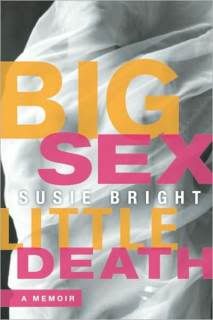
Review: Big Sex, Little Death

Big Sex, Little Death
by Susie Bright
Seal Press, 2011

Some people are just extraordinary. There's no other way to say it. Some people, for some reason, have the courage to live big adventurous lives. I've met a few of them and I'm convinced it isn't something they do on purpose. They've never made a conscious decision to be that way and frequently they don't even realize they are that way. If you ask them they'll say that it's chance that has always led them to the center of things. They don't see that they have some sort of internal compass that points them towards adventure and a personal gravity that draws others into their orbit. Susie Bright is one of those people (though I'm ninety-nine percent sure she's one of the ones who would deny it).

Her new book, Big Sex, Little Death, is a memoir of the first half of her life. It begins with her childhood and ends shortly after the birth of her daughter in the early 1990s. In a way, it's a shame it doesn't go further, but then Susie has written a great deal about the other parts of her life in other books and her excellent blog. Those were the days when she was "Susie Sexpert" -- a nickname she now dislikes -- the one who kept us apprised of the Sexual State of the Union, told the Wachowski Brothers and two straight girls how to finger fuck, and still makes sure we had top quality stories to read while we masturbate. That was the Susie Bright I was familiar with. For the purpose of this review, let's call that one Susie Version Four. Even though I read her blog quasi-religiously I didn't know how much of the picture I was missing until Big Sex, Little Death came along.

This book deals almost entirely with Susies One through Three. Susie One was a bookish young girl whose college professor parents met living in India. She was raised in California. After her parents divorced her mom took her to live in Edmonton, Alberta. Unfortunately, her mother's bitterness about the glass ceiling that kept women from getting very far in the world of academia translated to some borderline abusive, borderline suicidal behavior, so Susie learned to walk on egg shells. After Susie was injured in one of her mother's quasi-suicide attempts -- one of the most shocking moments in the book, to which I can't do justice in this summary -- her mother wisely sent her back to California to live with her father. The sheltered girl transfers to a high school in Los Angeles, and within a year has blossomed into Susie Two, who joins a student communist group called the Red Tide and starts experimenting with casual sex. Eventually she drops out of high school to become a Socialist labor organizer in Detroit and Louisville, where she is threatened with guns, witnesses a stabbing and has her apartment vandalized by the KKK. But a Party schism (what a cliché!) sends her packing. In San Francisco, she becomes Susie Three, a lesbian, a vibrator expert in a feminist sex toy store, and front line infrantrywoman in a feminist culture war. As a contributor and editor of On Our Backs, the first lesbian porn magazine, she's accused of helping the patriarchy enslave women by the sex-negative, second-generation feminist movement.

I bought this book because I was interested in Susie's life as a sex-positive celebrity. Interestingly enough, that's the part I found to be the least spellbinding. I was most enraptured by the stories about her childhood and about her political awakening. Those were the moments when I felt like, after all these years of learning about what Susie does, I was finally learning who she is. Throughout the book, Susie comes off as strong, intelligent, adventurous and endearingly vulnerable. She seems to always be in just a little over her head -- so reliably over her head, in fact, that you can only conclude that that's where she wants to be.

There is one thing in this book that I did find a little bit shocking. No, it wasn't the fact that, at sixteen, Susie was running around having casual sex with all of the International Socialists. Susie's mostly regret-free sexual adventures were fun to read, and (dare I admit it?) pretty hot. No, the thing that shocked me was none of the intelligent, serious thirty-year-old Socialist men she meets seems to have any problem having sex with someone so young. Maybe I'm being extremely naïve, but this seemed like a huge generational difference. I remember being hit on by a seventeen-year-old one time and being quite frankly frozen with inhibition -- and I was only twenty-three at the time! I feel like I grew up in a generation where it's generally held that high schoolers should fuck high schoolers, college students should fuck college students, and after that, anything goes. At almost thirty, I'd feel wrong hitting on a college girl. It's hard to believe things were so different just thirty years ago.

That's my only complaint. It's not really about the book at all, and it's probably just my latent sex-negativity talking. Besides that recurring "yuck" moment, I can recommend this book with my whole heart. Get a copy. If you know any feminists, get them a copy too. (Mother's Day is coming up!)

Thursday, March 31, 2011

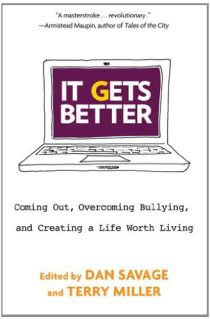
Review: It Gets Better, by Dan Savage and Terry Miller

It Gets Better
by Dan Savage and Terry Miller, ed.
Dutton, 2011

Last Tuesday, March 22, was the release date of the It Gets Better Project book and I was at the TriBeCa Barnes & Noble to see Dan Savage, Terry Miller and a few other contributors read from it. The project is probably the greatest thing Dan Savage has ever done. That's saying a lot, but I think it's the truth. It isn't the funniest, and wittiest or the most complicated but I think that Dan has gone from saving people's sex lives to saving their lives, period.

After the reading, I stood in line to get two copies of the book signed. When I got to the front of the line I told Terry and Dan that one copy was just for me, but the other copy was for a high school student I met a few years ago. I spent a year as an assistant ESL teacher in a high school and, during a tutoring session, my best student came out to me. At the time he was just out to his parents. No one in the school knew. I'm still not sure why he picked me to be the person he told. I may have, at one point, displayed a certain openness towards homosexuality and polyamory in a general way. He also may have seen me reading a novel by Jean Genet and gleaned that I was an ally from that. But I think the reason he told me is that I had no reason to care whether he was gay, one way or another. I was the low-risk option -- not really his peer, nor really his teacher (as an assistant teacher, I wasn't even empowered to give grades). For awhile, I was the only person he had to talk to about gay issues. We stayed in touch after I moved on. He still isn't completely out to his friends (and I worry about him sometimes), but some sort of progress is being made -- last summer he came to visit me in New York and we had a drink in the Stonewall Inn. After I finished telling Terry and Dan the story, Dan shook my hand and thanked me for being there for a gay kid at such an important moment. I was really proud at that moment (Dan Savage shook my hand!) but I also felt like I didn't deserve to be proud. I didn't really do that much. It isn't that hard to be there for someone when they need you.

The It Gets Better Project is all about being there for gay kids who have nothing else. The book (which is mostly transcripts of the It Gets Better videos that have been popping up on YouTube since last summer) aims to do that. It contains 103 versions of what is essentially the same story: The writer had a tough time as a kid in high school. They were harassed mercilessly, maybe by their own parents, maybe even to the point of considering suicide. But once they got out of high school they were able to find a community of people who accepted them and build a life for themselves better than anything they'd ever dreamed of. Some of the letter writers are famous (Barack Obama, Gene Robinson, Ellen, Michael Cunningham, Alison Bechdel, David Sedaris, Perez Hilton), some are just ordinary lesbian, gay, bisexual, trans and queer people. There's an essay in Spanish, and one in Arabic. There are cartoons. The evidence being offered is anecdotal but as the same story is repeated over and over again it takes on a certain statistical quality. When every story ends the same way, it becomes easier to believe that yours will too.

My only criticism of the book (and it hardly qualifies) is that, in text form, many of the messages aren't quite as powerful as they are on video. But whatever is lost by the individual messages is more than made up for by having so many of them packaged together. And it is undeniable that this message needs to be out there in as many different forms as possible, taking advantage of many different media. This book can go places the Internet videos can't, and vice versa. If the recent gay teen suicides have taught us anything it is that this message needs to be out there in as many forms as possible.

Saturday, March 19, 2011

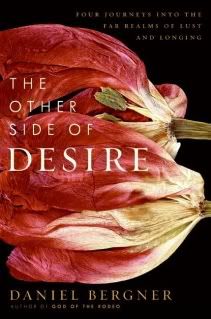
The Stacks - The Other Side of Desire

The Other Side of Desire
by Daniel Bergner
Ecco, 2009

This book presents four true profiles of people who have sexual desires that are considered unusual. The first is Jacob, who is a Midwestern businessman with a severe foot fetish. He can’t derive sexual pleasure from anything besides a woman’s feet but he is ashamed of his fetish, can’t conceive of admitting it to his wife, and has fallen into the hands of a quack psychiatrist who has treated him with chemical castration. This hasn’t knocked out the fetish however, and he occasionally considers suicide for relief. The second profile is of the Baroness, a designer who creates latex clothing in her East Village boutique, staffed entirely by her submissives. The Baroness is a sadist who is in a vanilla and sexually monogamous marriage but does extreme BDSM play with others on the side and is a fixture in the NYC kink community. She is very well adjusted in her alternative lifestyle and sees her sadism as a service she provides to help masochists discover themselves. The third profile is of Roy, a man with apparently normal sexual appetites who suddenly discovered an attraction to young girls and was arrested for making a pass at his step-daughter’s friend. This chapter goes into recent research into the causes of pedophilia and points out that a great many men have a desire for the young but know better than to act on it. The fourth profile is of Laura and Ron Parisi. She becomes a double amputee after being hit by a car. He is an advertising photographer who has both an emotional and physical attraction to disabled women and is making a photo series of them based partly on the work of surrealist artist Hans Bellmer. The two meet during this project and end up getting married.

One criticism I've heard of this book from members of sexual minorities is that it's written for vanilla people who want to satisfy their curiosity. This is true, as far as it goes, but I don't think it's a strike against the book. Berger treats his subjects with compassion and tries valiantly to help outsiders understand their unusual sexual tastes. He never sensationalizes (although to book cover does with the subtitle, "four journeys into the far realms of lust and longing"). We never get the impression that he's the emcee at a freak show. His sympathy for Jacob, the foot fetishist, is clear, as is his hostility to the psychiatrist who is making Jacob's life so miserable by feeding his shame. The Baroness also comes off well, and I think any reader that didn't come to the book hostile to BDSM will respect her for her ability to create a community around herself (not to mention to maintain her marriage to a vanilla man). And Berger is at his best during the portion of the book about Ron, the amputee fetishist. As I read Berger's poetic descriptions of Bellmer's strange artwork and Ron's photography, I actually felt my perceptions changing and started to see a strange beauty in something I might have normally considered unsightly.

The third section, about Roy, the pedophile, is the most disturbing part of the book, and it's where I have the most trouble affixing my stamp of approval. Pedophilia is such a taboo and the act of abusing children or teens is such a disgusting one that it is difficult to look at pedophiles as tortured, pitiable men. Berger's writing is strong enough that it makes the reader feel this way, on occasion. It's an extremely uncomfortable feeling to have. It's difficult not to feel that even a hint of pity for a pedophile, even one who suffers silently and never abuses a child, makes us complicit in their evil behavior. Berger's ability to make us feel something for them to a testament to his writing. However, unlike the new perspective he offered me in the amputee section, I'm not sure I want to thank him for the new insight in this case. This is one area where I would sort of prefer to keep my mind closed and impermeable.

I've heard kinky folk criticize this book because they're being lumped in with pedophiles and I would wager that foot and amputee fetishists feel the way (I'm not acquainted with any). I sympathize with that. To compare their consensual and harmless behavior with the sexual exploitation of children is to conflate transgressive behavior with something that is unethical and wrong. And yet Berger may have a point. All through pedophile section he is trying to tell us that pedophiles aren't that unusual, and that the main difference between normal men and men like Roy, who attempt to have sex with young girls, isn't so much the lack of attraction to a girl below the age of consent as the willingness to act on these feelings. After all, hasn't Roy been able to sustain regular, vanilla, heterosexual relationships? Didn't his aberrant behavior surface only after years of apparently normal sexuality? Even he was unaware that he had any particular inclination towards the young. Berger seems to be leading us towards the conclusion that Roy, out of all of the book's subjects, is the most normal.

Whether or not you enjoy this book is going to depend on your reaction to the pedophilia section. Do you enjoy being challenged with these sort of ideas? Are you okay with being made extremely uncomfortable by some of the conclusions they lead you to? Do you want to reexamine your beliefs on this subject? If the answer is yes, there's no question that you'll love this book. If not, steer clear of the third section and you'll be on safe -- and less challenging -- territory. The book will be pleasant and won't create any strong reaction. For my part, as uncomfortable as it was I was glad I read it. Frequently the ideas that are the least comfortable are the ones most worth thinking about.

Tuesday, April 6, 2010

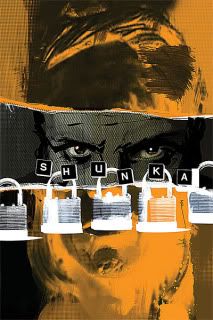
The Stacks - Scalped #36

Scalped #36: "A Fine Action of an Honorable Catholic Spaniard"
written by Jason Aaron
illustrated by Davide Furnò
DC Comics/Vertigo, 2010

You may not be familiar with Scalped. It certainly hasn't done anything before now would warrant mentioning it on a blog like this. It's a crime comic book that follows the adventures and misadventures of a number of Native American cops and robbers on a Lakota reservation is South Dakota, a reservation haunted by violent years of government repressionand civil rights activism in the 1970s. (For a brief history lesson, click here.)

Scalped has been compared to The Sopranos, except with Indians instead of mafiosos. So far the series has focused on the undercover FBI agent and general badass Dashiell Bad Horse. He is trying to take down corrupt tribal elder and casino owner Lincoln Red Crow -- and discovering things are not as morally black and white as he assumed. The series also features an ensemble cast from all walks of reservation life, many of whom it has only begun to explore 36 issues in.

One of these is Shunka. He's Red Crow's trusted right-hand man, doer of the dirty work. He's part hitman, part consigliere, always in the background, the only man on the reservation who might be a bigger badass than Bad Horse. Writer Jason Aaron hasn't developed the character beyond that. Issue #36 opens with Shunka breaking and entering, holding a man at gunpoint, threatening to kill him -- then embracing him and fucking his brains out. Shunka is gay, and deep in the closet.

The issue explores homosexuality and homophobia among modern American Indians. Shunka's lover Joseph Crane tells him that Indians traditionally respected gay and transgender people, whom some tribes dubbed Two-Spirits, but that in modern times they have assimilated the homophobic attitudes of the white rural communities surrounding their reservations. In the story, Crane is a tribal leader in a neighboring state who embarrassed the wrong people by coming out. Shunka is there to help intimidate him into silence but it doesn't work and Joseph Crane ends up murdered. Shunka's first reaction is to shrug and leave town, but he has started to fall for Crane. The issue ends with Shunka deciding to unleash his own brand of justice on the men who murdered Crane.

Since Scalped is frequently compared to The Sopranos, people are going to want to compare Shunka to Vito Spatafore, the closeted mobster who is outed and eventually killed on that series. But the comparison doesn't do Scalped justice. Jason Aaron is giving us a much more interesting portrayal of homophobia in gangland. Vito Spatafore's story always rubbed me the wrong way -- the moment he was outed is he suddenly becomes every gay cliché in the book, as if now that he's out he's reverting to type. One moment he's a mob enforcer, the next he's going to BDSM clubs in full leather gear, running away to a small town in Massachusetts to hang around in antique shops and live in domestic bliss with a tough but sensitive biker. Shunka, by contrast, remains the same person after we learn he's gay. Before, he was a violent badass that we didn't really like. That hasn't changed -- although, romantics that we are, we're rooting for him to get justice for his murdered lover.

That's the reason why Scalped is handling its gay story better than The Sopranos did -- no stereotypes. Shunka is a criminal and a murderer. He doesn't go running to the antique shop when we find out he's gay. He stays true to form and gets ready for a blood bath, gay stereotypes be damned. This story is not being played for laughs. It is deadly serious.

The story concludes in Scalped #37, on sale on April 28.

Wednesday, February 3, 2010

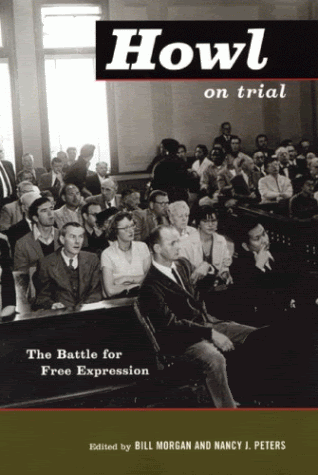
The Stacks - Howl on Trial

Howl on Trial
edited by Bill Morgan & Nancy J. Peters
City Light Books, 2006

Allen Ginsberg's poem Howl was first published by the small press run by San Francisco's famous City Lights Bookshop in 1956. The books, printed in the UK, were seized by Customs as they entered the US on the grounds that they were obscene material. The seizure created enough press to justify a second edition, which City Lights owner Lawrence Ferlinghetti had printed locally so that Customs would have no authority. In 1957, undercover officers purchased a copy of the book at the bookstore and then brought charges against Ferlinghetti and the clerk that sold the book. The book was labeled obscene and banned. The court case that followed was one of about a dozen cases that changed America's strict obscenity laws so that books that employed gutter language and sexual imagery (frequently homosexual imagery) in pursuit of lofty literary goals could be sold in the Land of the Free.

Reading Howl, it isn't difficult to spot the passages that the censors may have objected to.
who lost their loveboys to the three old shrews of fate the one eyed shrew of the heterosexual dollar the one eyed shrew that winks out of the womb and the one eyed shrew that does nothing but sits on her ass and snip the intellectual golden threads of the craftman's loom,

who copulated ecstatic and insatiate with a bottle of beer a sweetheart a package of cigarettes a candel and fell off the bed, and continued along the floor and down the hall and ended faiting on the wall with a vision of ultimate cunt and come eluding the last gyzym of consciousness,

who sweetened the snatches of a million girls trembling in the sunset, and were red eyed in the morning but prepared to sweeten the snatch of the sunrise, flashing buttocks under barns and naked in the lake,

who went out whoring through Colorado in myriad stolen night-cars, N. C., secret hero of these poems, cocksman and Adonis of Denver -- joy to the memory of his innumerable lays of girls in empty lots & diner backyards, moviehouses' rickety rows, on mountaintops in caves or with gaunt waitresses in familiar roadside lonely pettycoat upliftings & especially secret gas-station solipsisms of johns, & hometown alleys too, (...)

In the end, the publishers convinced the court to rule that Howl was a serious work of literature, to add support to the legal precedent set during the Ulysses obscenity trial that held that an artistic work must be judged as a whole and not on the basis of a few passages taken out of context, and slam the door on the argument that a serious work of literature could be banned entirely because it was unsuitable for children.

Howl on Trial is a fantastic record of these historical events. It contains some historical perspective -- an introduction by Ferlinghetti, a timeline of important dates in the history of censorship, etc. -- but the genius of the book is that it tell most of its story through primary source material. It contains the text of Howl, news articles, editorials and criticisms by famous critics, letters to the editor by ordinary San Francisco citizens both in support of and in opposition to the poem, and the full transcript of the trial.

This is going to be a short review since there isn't much to review. You can't exactly criticize a court transcript based on its literary merit! If you are interested in history, if obscenity trials interest you as much as they interest me, you will find this account as fascinating as I did.

I have only one complaint that I wish the book had addressed. It is all well and good that Howl was ruled to be literature and not smut -- and therefore not subject to censorship. But what about the smut? Neither the historical figures, nor the historians who contribute their opinions stand up for the rights of authors and publishers to publish obscene material that doesn't have literary value. That omission makes me think we might not have come as far since 1957 as we think we have.

Tuesday, January 19, 2010

The Paradox of 1960s Erotica


This weekend I was in Chicago to visit Annabelle and to do some research on a new project. For the project (which I'll talk about later), I spent part of the day on Saturday and Sunday at the Leather Archives & Museum in East Rogers Park looking at vintage erotica and learning about the history of the Chicago gay leather scene. I've already written almost a year ago about LA&M's exhibits on the history of the gay leather community in Chicago and their wonderful collection of books about BDSM -- I'm still looking for a private collection to equal it in New York.

Most of the erotica that I looked at at LA&M this weekend was the pulp variety from the 1960s. It always strikes me how very different old erotica is from today's variety. Today, erotica stories tend to be fairly realistic depictions of sexual encounters you could actually have. Not so in the pulp stories of the past. Those stories are full of fantastic and bizarre situations. They take place in exotic locales -- Europe, New Orleans and (the most debauched of all) New York. They're filled with immoral Oriental girls and insatiable mulattos who coerce their victims with razor blades. And despite the fact that these books were being labeled obscene and their writers, publishers and distributors persecuted for being moral degenerates, the stories are -- fascinatingly -- full of negative messages about sex. Promiscuous female characters are shamed as sluts and harlots. As surely as the sun rises, a woman who gets a taste of sex will fall into a spiral of depravity and degradation, homosexuals usually end up dead, and sadists are possessed of an uncontrollable bloodlust that inevitably leads to murder.

This echo of moral judgement is one of the most fascinating things about erotica of this period -- the very condemnation and sex-negativism that interfered with the sale of this kind of material is the source of most of most of its stories. It nearly qualifies as Stockholm Syndrome. The books ridicule and perpetuate harmful stereotypes about the very kind of people who presumably consumed them. Why do the authors and publishers decry and lament the conditions that allow them to make a living? Why do the readers of these appreciate such a thorough denunciation of perverts like them (or, at least, the type of pervert they would be if they could find the courage)? It is paradoxical, so say the least!

Another striking thing about these books is how many of them insist that the subject matter is true. Often this comes as a disclaimer on the cover or before the title page that goes something like this: "I wish I could tell you what you're about to read was fiction but, sadly, every horrible word of it is true." It then goes on to explain that the names, locations and other particulars of this true account have been changed to protect the identity of the characters from anyone who might try to fact-check the "true story."

Another variation on this theme is the so-called "documentary" book. These expose the "sordid" details of the underground sexual communities of the day -- homosexuals, sadomasochists, sex workers -- in a format that poses as either journalism or psychology. One suspects from the very unrealistic dialogue in the "interviews" that the material in most of these books is made up wholesale, but some of the most famous ones are probably actual reportage. These books are so fascinating because they both condemn sexual "perversion" while at the same time feeding it. I mean, for what reason would anyone buy such a book except for the thrill of reading about all the hot things it condemns? One wonders how many people found their sexual subcultures after reading condemnations of them in books like Louis Berg's The Velvet Underground.

***

While at the Leather Archives, I also had the chance to see a fascinating documentary by filmmaker Ron Pajak called Quearborn and Perversion. The film details the history of the gay community in Chicago, beginning in the 1934 and ending in 1974. The film was a fascinating account of what it meant to be gay and lesbian in one of America's toughest cities at that time. It takes it's name from the Chicago police department's nickname for the corner of Dearborn and Division Streets, a prominent gay cruising area at that time.

I wish I could discuss the film at length but I was recovering from the flu that night and rather loopy, so some of the details are eluding me today. However, I did very much enjoy the Q&A after the film with director Ron Pajak and Chuck Renslow, who opened the famous leather bar Gold Coast in June 1958 and spoke very eloquently about the period, including some interesting anecdotes about bribing the police to avoid raids.

Thursday, August 27, 2009

The Stacks - Brokeback Mountain


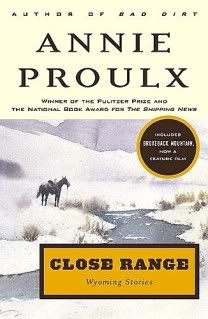
“Brokeback Mountain,” from Close Range: Wyoming Stories
by Annie Proulx
Scribner, 1999

A few weeks ago I was reading the Spring ’09 issue of The Paris Review (yes, I do read things that aren’t about sex). It features an interview with Annie Proulx, writer of “Brokeback Mountain” and The Shipping News and in that interview I there was a passage I found extremely surprising and though provoking.

INTERVIEWER: You’ve said that the characters of Jack and Ennis from “Brokeback Mountain” were the first two characters that started to feel “very damn real” to you. (…)

PROULX: (…) I think it happened with “Brokeback Mountain” because it took me so long to write that story. It took at least six weeks of steady work, which is not my usual pace. So yeah, they got a life of their own. And unfortunately, they got a life of their own for too many other people too.

INTERVIEWER: What do you mean?

PROULX: I wish I’d never written that story. It’s just been the cause of hassle and problems and irritation since the film came out. Before the film it was all right. (…) But the problem has come since the film. So many people have completely misunderstood the story. I think it’s important to leave spaces in a story for readers to fill in from their own experience, but unfortunately the audience that “Brokeback” reached most strongly have powerful fantasy lives. And one of the reasons we keep the gates locked here is that a lot of men have decided that the story should have a happy ending. They can’t bear the way it ends—they just can’t stand it. So they rewrite the story, including all kinds of boyfriends and new lovers and so forth after Jack is killed. And it just drives me wild. They can’t understand that the story isn’t about Jack and Ennis. It’s about homophobia; it’s about a social situation; it’s about a place and a particular mindset and morality. They just don’t get it. I can’t tell you how many of these things have been sent to me as though they’re expecting me to say, Oh great, if only I’d had the sense to write it that way. And they all begin the same way—I’m not gay but… The implication is that because they’re men they understand much better than I do how these people would have behaved.

The first thing that occurred to me is that Annie Proulx, as a literary author, leads a pretty sheltered life compared to some writers with a wider following in pop culture. It’s sort of funny to imagine her curiously reading the mountains of slash fiction arriving at her Wyoming ranch. A different writer—say, Joss Whedon, who created the lesbian couple Willow and Tara from Buffy the Vampire Slayer, equally influential to a certain group, in their own way, as Ennis Del Mar and Jack Twist, and also controversally doomed—would never look at these fan stories. Whedon probably has an assistant whose job is to round file that stuff. You have to feel a little sorry for Annie Proulx, who was not prepared for the consequences of a couple of her characters accidentally becoming pop culture icons.

But, on the other hand, Proulx is right. "Brokeback Mountain" is not a novel. The fantastic film by Ang Lee significantly expands the scope of what is, after all, a short story. Not just a single short story but an installment in a collection of short stories about Wyoming cowboys. Annie Proulx is a very geographical author. The books and stories she writes are about the places the stories occur, not the characters. Proulx characters are frequently the inevitable product of the places they live more than autonomous human beings.

The beauty of "Brokeback Mountain" the short story, as opposed to the movie, is the sense of longing Proulx captures. "Brokeback" the story lacks the movie's grandiose dramatic moments. Proulx tells us little about Jack Twist's life when he's outside of Ennis's company, instead focusing on Ennis, the patient cowboy who over the course of the story watches his entire life pass by as he floats from job to job, living only for the occasional fishing trip with his lover. The story, like the movie, is a tragedy but it is a quieter, more desperate kind of tragedy. It is the tragedy of a man who embodies the socially conservative, homophobic Wyoming cowboy lifestyle in every way except that he happens to be gay -- a fact that his place and time will never allow him to acknowledge and embrace.

Proulx brings up the fact that she is a woman in the interview, and I think that is one of the greatest things about this story. It has really earned a place as one of the watershed pieces of gay literature, yet it was written by a straight woman. In my opinion, we shouldn't be so surprised. It would take an outsider to take this story about an oppressed minority and make it so universally powerful.

Friday, July 3, 2009

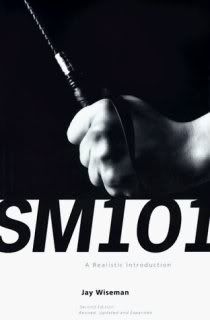
The Stacks - SM 101


SM 101, 2nd ed.
by Jay Wiseman
Greenery Press, 1996

So, you like rough sex. You want to explore it but you have this nagging feeling that it could be... oh, I don't know, a little bit unsafe. Jay Wiseman to the rescue! In just over three hundred pages Wiseman gives you a basic rundown on the safe and responsible ways to incorporate pain and power exchange into your sex life.

The book is perfectly titled -- if your college had offered a freshman seminar in BDSM this is exactly what would be covered. After dispensing with the basics Wiseman touches on how to find partners, rope bondage, non-rope options for restraint, how and where hit a submissive to cause pain safely, different flagellation instruments (hands, floggers, paddles, crops, whips, canes and the like), how and where to use clamps, a whole plethora of sensation play, humiliation, how to train a submissive, how to have a BDSM relationship, and how to find the BDSM organization in your area or create one if it doesn't already exist.

All of this information is first rate. As a former paramedic Wiseman always errs on the side of safety. He believes (as most responsible S&M players do) that if what turns you on is particularly dangerous there is probably some way of at least simulating your kink safely. As a decent human being he advocated doing BDSM with respect for everyone involved. That means negotiating your scene in detail with your play partner ahead of time. Throughout his book Wiseman makes sure that his reader never forgets that even if the violence is real (though carefully controlled) the power inequality of BDSM is entirely pretend. Even if one person acts dominent and another acts submissive they are both equals who should never confuse the roles they play with reality.

The main criticism I've heard of SM 101 in kink circles is that Wiseman is just too cautious. I see why people say that. It was a little surprising to me that Wiseman introduces his intricate "silent alarm" technique (wherein if a third party isn't contacted by the submissive by a prearranged time the third party calls the cops) before even covering the idea of a safeword. At another time in the book Wiseman suggests that all responsible dominents should keep emergency lights and full size fire extinguishers in their playroom. Valid safety concerns, without a doubt, but most of us don't even have a playroom. For most of us, it's just our bedroom and we have a small stash of kinky stuff in the closet that we'll take out if a willing person happens to wonder in. Despite what Wiseman says, most people just steer clear of open flame and play the odds that there won't be a blackout. I don't think that's blatantly irresponsible. And a scene negotiation would take years if you really covered all the things he's suggesting be covered in detail. However the point of these parts of the book is more to instill a deep respect for safety than to require the reader to follow the instructions to the letter, so Wiseman's overzealousness is easily excused.

The one criticism I will add -- this book is badly in need of a third edition. Since 1996 the kink community has largely moved onto the Internet. This book's discussion of the kink community mainly focuses on alternative papers, bulletin boards in sex-positive stores, newsletters and getting a PO Box to protect your privacy. The only time Wiseman mentions the web is to suggest a couple of newsgroups (remember those? me neither) that might have information. An SM 101 that urges readers to take full advantage of online communities like Fet Life would be a much more helpful book for newbies who are looking to make a connection with the kink community, especially if they don't happen to live in New York or San Francisco.

Despite these problems I would absolutely recommend this book. Experienced players may learn a thing or two about safety. For beginners, this should be the first book they read.

Monday, May 4, 2009

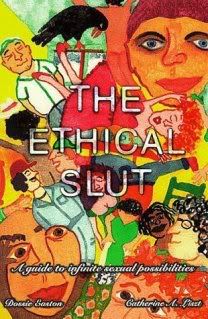
The Stacks - The Ethical Slut

The Ethical Slut, 1st ed.
by Dossie Easton and Catherine A. Liszt
Greenery Press, 1997

This is it -- the original polyamory manifesto, the old stand-by for college students looking to sow some wild oats, aging hippies holding on to free love... and, of course, the rest of us. In a single volume Dossie Easton and her writing partner Janet Hardy (writing under a pen name here) lay out the case for having multiple relationships concurrently with the full knowledge and consent of everyone involved.

The Ethical Slut was a truly groundbreaking book. It came out at a time when the idea that a person could practice nonmonogamy openly and with the full consent of everyone involved was a revolutionary one. Very few people had proposed that jealousy is a cultural construct that can be fought, dealt with and overcome rather than a bred-in-the-bone instinct against which we were completely powerless. It was the dawn of the Religious Right, so Easton and Hardy were certainly bucking the trend by suggesting that sex is fun and pleasure is good for you.

The book had some faults that later books like Tristan Taormino's Opening Up would improve upon. Easton and Hardy were focused primarily on what Taormino would later term "partnered nonmonogamy" (where each person has one primary partner, plus a few secondary partners) and more or less neglected other kinds of polyamory. Their research was limited mainly to their own experiences and those of their friends, and so the book left some doubt that nonmonogamy could be successfully implemented outside of San Francisco aging-hippie circles. But despite these shortcomings and a multitude of other books that tried to do better (with occasional success) The Ethical Slut remained the gold standard in polyamory guides for more than a decade.


The Ethical Slut, 2nd ed.
by Dossie Easton and Janet W. Hardy
Celestial Arts, 2009

This past March, Easton and Hardy (now fully out of the closet and publishing under her real name) finally returned to give their most famous book an update. You're probably asking, "Should I bother reading the second edition if I've already read the first one?" I think the answer is probably yes.

Twelve years ago The Ethical Slut was doing something that was totally unheard of -- presenting ethical polyamory with all the attendant consent and communication as an alternative to lifelong monogamy. This absolutely revolutionary proposition required the book's authors to set up a dichotomy between monogamy and polyamory, examining the underlying assumptions of a monogamous culture. Well, times have changed. In the last twelve years open relationships have gone from being the subject of shame, scandal and intense secrecy to the subject of popular TV shows. A few years after the first edition came out in 1997 people widely began to speculate that Bill and Hillary Clinton might have an open relationship and the visibility of nonmonogamy only increased from there.

There's no need for The Ethical Slut to be a polyamory manifesto anymore. The idea is in the zeitgeist already. At times, reading the second edition, I missed the old, proselytising Slut with its blatant and sometimes slightly outrageous challenges to conventional relationships. But when I feel a sense of loss I have to stop and admit that it's probably a good thing that Easton and Hardy have stopped trying to pass themselves off as sociological experts by floating complicated theories about monogamy's supposed roots in outdated agrarian cultures. The Ethical Slut has given up this type of missionary work to finally become what it was intended to be all along -- a relationship book.

The new edition is a longer read and it's been edited so it focuses more purely on relationship styles. Passages of the old book that presented polyamory as a challenge to monogamous values have been cut or placed in a context that deemphasizes them. In their place Easton and Hardy have supplied even more wise suggestions for communicating with your partners as well as exercises that can be done alone to gain insight into oneself or as a couple to build intimacy.

The second edition builds admirably on the shortcomings of the first but doesn't overcome them completely. In 1997, Easton and Hardy's expertise on polyamory seemed to come with a lot of speculation and optimism. Now after twelve years as polyamory experts they've encountered enough poly people to speak with real authority. However the focus remains limited to San Francisco -- readers who are put off by talk of hippie ideas like tantric sex had best read Jenny Block's Open instead. While the book remains focused on partnered nonmonogamy the chapters on solo polyamory and group arrangements are more prominent.

My overall impression of the second edition is that The Ethical Slut has grown up. The book, like its authors and readers, seems to have gained experience and become a little wiser with the years. This book is no longer a polemic. It's just a guide to the hard work necessary to live a polyamorous lifestyle.

Wednesday, April 22, 2009

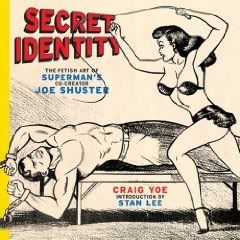
The Stacks - Secret Identity


Secret Identity
by Craig Yoe
Abrams ComicArts, 2009

In 1937, Joe Shuster and his boyhood friend Jerry Siegel created the first and arguably the greatest of all superheroes -- Superman, The Man of Steel! Fifteen years later, having lost the rights to his character to DC Comics in a bitter lawsuit, Shuster took a very different kind of job: illustrating the S&M pulp magazine Nights of Horror, sold under the counter in Times Square bookshops. This fact has only recently come to light when author Craig Yoe, a comics archivist, recognized Shuster's distinct artwork. It should have come to light much sooner because Shuster had a tendency to make his fetish drawings resemble the Man of Steel and his supporting cast.

The drawings themselves are simple pen and ink sketches which illustrate kinky pulp stories (included in this book only in summary form, alas). The pictures are still tintalating today although they don't hold a candle to modern BDSM porn in terms of graphicness. Still Shuster depicts a surprising variety of kinky activity: men and women in both the dominent and submissive role, manacle restraints, single-tail whips, canes, paddles, lesbianism, voyeurism, master/slave activities, rope bondage, electrostim and branding all make appearences (although male homosexuality is nowhere to be seen). Notably missing is the black leather fetish look that is so ubiquitous today -- in the mid-'50s this look hadn't yet migrated from gay biker fetishism to the straight imagination so here we see mostly lingerie or plain old nudity.

A 35-page essay at the beginning that gives the basic history -- that Shuster, hurting for cash after being blacklisted, illustrated the kinky stories and that, when Nights of Horror was connected to a group of Brooklyn teen thrill killers by anti-comics crusader Fredric Wertham, the State of New York banned the publication and had it destroyed. Shuster was never connected to the work which was fortunate for him. The publisher and writer went to jail.

When reading this book it's important to remember that it's written for comics enthusiasts, not for alternative lifestylers interested in a fascinating period of censorship for "deviant" sexual tastes. To his credit Yoe writes about kink in a relatively positive way with the only possibly offensive moments owing more to cluelessness than anything else: at one point, Yoe holds up the fact that Shuster was short and liked to date tall women as possible proof that he was a submissive. Yoe seems to feel the censorship of Nights of Horror was an overreaction of a more innocent time -- my only complaint is that he doesn't bother to mention that numerous studies have failed to find any link between BDSM and criminality (though I'm sure many have tried!).

This complaint against Yoe is mild compared to the bone I have to pick with Stan Lee's introduction. Lee writes, "Whereas everything about the stories and artwork of Superman was positive and morally uplifting, the pages of Nights of Horror that appear in Secret Identity cater to the basest of man's character and morals." Apparently the creator of Spider-Man and X-Men has never noticed in his long career that violence, rope bondage and busty, scantily-clad women occur with delicious frequency in superhero comics as well.

Sunday, March 22, 2009

The Stacks - The Smart Girl's Guide to Porn


The Smart Girl's Guide to Porn
by Violet Blue
Cleis Press, 2006

It's a sign of the culture we live in that every informational sex book begins with a section where the author, like a skilled bomb squad engineer, slowly and painstakingly defuses the reader's secret shame and guilt about their sexual desires. The existence of this section -- the first fifty pages of your average sex book -- is doubly surprising when you consider the reader had to be interested and open-minded enough to go to go to an independent book store (because good luck finding a decent sex book at Barnes & Noble) and buy the book in the first place!

This fifty page section stands out even more than usual in The Smart Girl's Guide to Porn, which is only 120 pages long. Yes, it is okay for girls to look at porn. No, it's not just for men. Yes, there will be things that turn you off or offend you. No, you should hold that against porn in general.

In writing a book for women about porn Violet Blue knows how much prejudice she has to overcome. Until very recently, porn -- a film genre with endless variety, as Blue points out -- was all painted the same very black color by feminists. Generations of women have learned that porn exploits and disrespects their gender. Violet Blue cops to that. Some porn does, she admits. But other porn doesn't mistreat or exploit its female performers. Some is even produced by women, for women. Don't burn down the barn to get rid of the rats.

For those readers who don't need to be convinced porn isn't always bad, it's best to skip ahead in this book. Most of the information this book has to offer is in Chapter 6, which is about the mainstream porn industry, and Chapter 7, which is about Internet porn (at three years old, the book's web addresses are mostly out of date, but the general information's still good).

Beyond the occasional visit to a free site I've never been a big consumer of porn (I doubt I could name a famous porn star who's still in the business) so I found these chapters very interesting. And occasionally disillusioning -- who knew Paris Hilton had to sign a release before her sex tape could be "leaked"? And then there's the other reason to read books by Violet Blue: that, unlike many sex writers, she has a fresh and witty writing style that makes every subject more interesting.

Tuesday, January 6, 2009

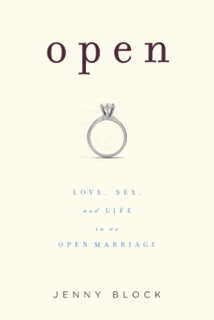
The Stacks - Open


Open: Love, Sex and Life in an Open Marriage
by Jenny Block
Seal Press, 2008

Jenny Block wants to make sure you understand that she's normal. She dated in high school and college, sowed some wild oats, experimented with bisexuality, then met a man whom she fell madly in love with, got married, had a daughter, moved to the suburbs, started a career, had some marital problems but worked them out through good inter-spousal communication and now lives with her husband in a stable, quiet open marriage. Wait, huh?

If you're already practicing polyamory or if you're familiar with it, Block's book won't be much of a revelation for you. The parts where she is explaining the logical reasons why she chose open marriage are the same as what you'll find in many other books on the subject, such at The Ethical Slut, by Dossie Easton and Catherine Liszt (aka Janet Hardy), or Opening Up, by Tristan Taormino. And the parts where she's relating her trials and tribulations as she worked out how to have an open marriage will be a story that you've heard a hundred times.

The book's contribution is its appeal to people who are not polyamorous, who have never met a polyamorous person and who freak out at the very idea of open marriage—the people who believe that if you're going to find love outside of your marriage, you should at least have the decency to lie about it to everyone you know. Those people can dismiss Easton and Hardy as established BDSM players in San Francisco. They can dismiss Taormino as a porn director and female anal sex expert. But they're going to have a harder time dismissing Block.

Block walks you step by step through her process of deciding to open her marriage. She doesn't sugar coat the mistakes she has made, nor does she claim to have discovered all the answers. While Block does take time out to discuss some of the built-in double standards and mixed messages aimed at women in monogamous marriages, her feminism doesn't go as far as The Ethical Slut (which theorizes that monogamy exists to pass on land in an agrarian society). By sticking to her personal experience and removing a lot of the politics of sexual liberation that can be off putting, Block has created a good introduction to polyamory for the uninitiated.

Monday, October 20, 2008

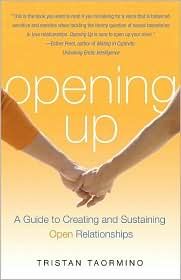
The Stacks: Opening Up, by Tristan Taormino


Opening Up
by Tristan Taormino
Cleis Press, 2008. English. 299 pp.

Polyamory is going mainstream -- or so the leaders of the polyamory movement keep telling us. At first glance monogamy seems to be firmly entrenched as the way western society falls in love but one sign of change is the number of books that have been published about poly relationships recently. Opening Up, by sex columnist and porn director Tristan Taormino, is one of the best.

This book isn't only about polyamory (the lifestyle choice of multiple open relationships at the same time). Taormino's ambitious goal is to explore all the alternatives to traditional monogamy, and to do so she relies on far more than her own experience -- she conducted interviews with 126 practitioners of alternative relationship styles. With their experiences to help her she defines six basic types of open relationship (partnered nonmonogamy, swinging, polyamory, solo polyamory, polyfidelity and mono/poly combinations) and proceeds to lay out the pros and cons of each, along with strategies to fight jealousy, weather sudden changes, come out to the people in your lives (or not), raise children and find compersion.

For more than a decade ago a book called The Ethical Slut, by Dossie Easton and Catherine Liszt (aka Janet Hardy), has been considered the definitive book on polyamory, the last word on the subject, so to speak. My question going into Opening Up was: Can Tristan Taormino find anything fresh that justifies writing her own book?

Taormino's broader approach, her determination to capture nonmonogamy in all its variety and complexity, does the trick. In the past, poly books have mostly focused on partnered nonmonogamy and polyfidelity. Taormino covers those, along with the usual communication skills that polyamorists value so. However, this book blazes some new ground by giving equal treatment to solo polyamory, nonmonogamy for people who temporarily or permanently aren't interested in a primary relationship; and mono/poly combinations, relationships where one partner is monogamous and the other isn't. This last type of relationship is extremely common, yet many people, monogamous and nonmonogamous alike, have difficulty accepting it. The poly partner must be taking advantage of the mono one, right...? (Wrong.)

This book also impressed me with its nuanced approach to the discussion of children in poly relationships. Since nonmonogamous people are not protected by the law, some of Taormino's interview subjects have lived nightmare scenarios, being declared unfit parents because they were out of the closet about their open relationships. In some cases, biological poly parents have even fewer rights than gay adoptive parents. That's an important thing to hear if you're considering this lifestyle, and something other books have been known to gloss over.

Those other poly books were written only from the authors' personal experience. That's where Taormino's research allows her to stand out. Other books have nothing approaching the variety of experience she's presents and that's why Opening Up succeeds so brilliantly.