Showing posts with label LGBTQ. Show all posts

Thursday, April 28, 2011

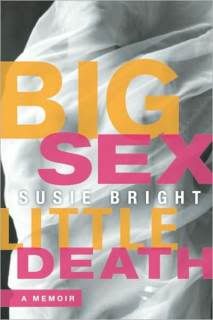
Review: Big Sex, Little Death

Big Sex, Little Death
by Susie Bright
Seal Press, 2011

Some people are just extraordinary. There's no other way to say it. Some people, for some reason, have the courage to live big adventurous lives. I've met a few of them and I'm convinced it isn't something they do on purpose. They've never made a conscious decision to be that way and frequently they don't even realize they are that way. If you ask them they'll say that it's chance that has always led them to the center of things. They don't see that they have some sort of internal compass that points them towards adventure and a personal gravity that draws others into their orbit. Susie Bright is one of those people (though I'm ninety-nine percent sure she's one of the ones who would deny it).

Her new book, Big Sex, Little Death, is a memoir of the first half of her life. It begins with her childhood and ends shortly after the birth of her daughter in the early 1990s. In a way, it's a shame it doesn't go further, but then Susie has written a great deal about the other parts of her life in other books and her excellent blog. Those were the days when she was "Susie Sexpert" -- a nickname she now dislikes -- the one who kept us apprised of the Sexual State of the Union, told the Wachowski Brothers and two straight girls how to finger fuck, and still makes sure we had top quality stories to read while we masturbate. That was the Susie Bright I was familiar with. For the purpose of this review, let's call that one Susie Version Four. Even though I read her blog quasi-religiously I didn't know how much of the picture I was missing until Big Sex, Little Death came along.

This book deals almost entirely with Susies One through Three. Susie One was a bookish young girl whose college professor parents met living in India. She was raised in California. After her parents divorced her mom took her to live in Edmonton, Alberta. Unfortunately, her mother's bitterness about the glass ceiling that kept women from getting very far in the world of academia translated to some borderline abusive, borderline suicidal behavior, so Susie learned to walk on egg shells. After Susie was injured in one of her mother's quasi-suicide attempts -- one of the most shocking moments in the book, to which I can't do justice in this summary -- her mother wisely sent her back to California to live with her father. The sheltered girl transfers to a high school in Los Angeles, and within a year has blossomed into Susie Two, who joins a student communist group called the Red Tide and starts experimenting with casual sex. Eventually she drops out of high school to become a Socialist labor organizer in Detroit and Louisville, where she is threatened with guns, witnesses a stabbing and has her apartment vandalized by the KKK. But a Party schism (what a cliché!) sends her packing. In San Francisco, she becomes Susie Three, a lesbian, a vibrator expert in a feminist sex toy store, and front line infrantrywoman in a feminist culture war. As a contributor and editor of On Our Backs, the first lesbian porn magazine, she's accused of helping the patriarchy enslave women by the sex-negative, second-generation feminist movement.

I bought this book because I was interested in Susie's life as a sex-positive celebrity. Interestingly enough, that's the part I found to be the least spellbinding. I was most enraptured by the stories about her childhood and about her political awakening. Those were the moments when I felt like, after all these years of learning about what Susie does, I was finally learning who she is. Throughout the book, Susie comes off as strong, intelligent, adventurous and endearingly vulnerable. She seems to always be in just a little over her head -- so reliably over her head, in fact, that you can only conclude that that's where she wants to be.

There is one thing in this book that I did find a little bit shocking. No, it wasn't the fact that, at sixteen, Susie was running around having casual sex with all of the International Socialists. Susie's mostly regret-free sexual adventures were fun to read, and (dare I admit it?) pretty hot. No, the thing that shocked me was none of the intelligent, serious thirty-year-old Socialist men she meets seems to have any problem having sex with someone so young. Maybe I'm being extremely naïve, but this seemed like a huge generational difference. I remember being hit on by a seventeen-year-old one time and being quite frankly frozen with inhibition -- and I was only twenty-three at the time! I feel like I grew up in a generation where it's generally held that high schoolers should fuck high schoolers, college students should fuck college students, and after that, anything goes. At almost thirty, I'd feel wrong hitting on a college girl. It's hard to believe things were so different just thirty years ago.

That's my only complaint. It's not really about the book at all, and it's probably just my latent sex-negativity talking. Besides that recurring "yuck" moment, I can recommend this book with my whole heart. Get a copy. If you know any feminists, get them a copy too. (Mother's Day is coming up!)

Thursday, March 31, 2011

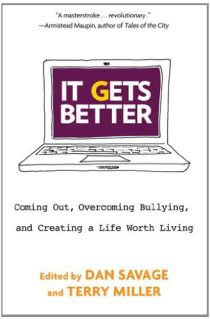
Review: It Gets Better, by Dan Savage and Terry Miller

It Gets Better
by Dan Savage and Terry Miller, ed.
Dutton, 2011

Last Tuesday, March 22, was the release date of the It Gets Better Project book and I was at the TriBeCa Barnes & Noble to see Dan Savage, Terry Miller and a few other contributors read from it. The project is probably the greatest thing Dan Savage has ever done. That's saying a lot, but I think it's the truth. It isn't the funniest, and wittiest or the most complicated but I think that Dan has gone from saving people's sex lives to saving their lives, period.

After the reading, I stood in line to get two copies of the book signed. When I got to the front of the line I told Terry and Dan that one copy was just for me, but the other copy was for a high school student I met a few years ago. I spent a year as an assistant ESL teacher in a high school and, during a tutoring session, my best student came out to me. At the time he was just out to his parents. No one in the school knew. I'm still not sure why he picked me to be the person he told. I may have, at one point, displayed a certain openness towards homosexuality and polyamory in a general way. He also may have seen me reading a novel by Jean Genet and gleaned that I was an ally from that. But I think the reason he told me is that I had no reason to care whether he was gay, one way or another. I was the low-risk option -- not really his peer, nor really his teacher (as an assistant teacher, I wasn't even empowered to give grades). For awhile, I was the only person he had to talk to about gay issues. We stayed in touch after I moved on. He still isn't completely out to his friends (and I worry about him sometimes), but some sort of progress is being made -- last summer he came to visit me in New York and we had a drink in the Stonewall Inn. After I finished telling Terry and Dan the story, Dan shook my hand and thanked me for being there for a gay kid at such an important moment. I was really proud at that moment (Dan Savage shook my hand!) but I also felt like I didn't deserve to be proud. I didn't really do that much. It isn't that hard to be there for someone when they need you.

The It Gets Better Project is all about being there for gay kids who have nothing else. The book (which is mostly transcripts of the It Gets Better videos that have been popping up on YouTube since last summer) aims to do that. It contains 103 versions of what is essentially the same story: The writer had a tough time as a kid in high school. They were harassed mercilessly, maybe by their own parents, maybe even to the point of considering suicide. But once they got out of high school they were able to find a community of people who accepted them and build a life for themselves better than anything they'd ever dreamed of. Some of the letter writers are famous (Barack Obama, Gene Robinson, Ellen, Michael Cunningham, Alison Bechdel, David Sedaris, Perez Hilton), some are just ordinary lesbian, gay, bisexual, trans and queer people. There's an essay in Spanish, and one in Arabic. There are cartoons. The evidence being offered is anecdotal but as the same story is repeated over and over again it takes on a certain statistical quality. When every story ends the same way, it becomes easier to believe that yours will too.

My only criticism of the book (and it hardly qualifies) is that, in text form, many of the messages aren't quite as powerful as they are on video. But whatever is lost by the individual messages is more than made up for by having so many of them packaged together. And it is undeniable that this message needs to be out there in as many different forms as possible, taking advantage of many different media. This book can go places the Internet videos can't, and vice versa. If the recent gay teen suicides have taught us anything it is that this message needs to be out there in as many forms as possible.

Tuesday, April 6, 2010

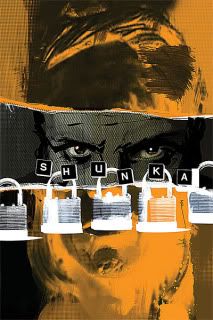
The Stacks - Scalped #36

Scalped #36: "A Fine Action of an Honorable Catholic Spaniard"

written by Jason Aaron
illustrated by Davide Furnò
DC Comics/Vertigo, 2010

You may not be familiar with Scalped. It certainly hasn't done anything before now would warrant mentioning it on a blog like this. It's a crime comic book that follows the adventures and misadventures of a number of Native American cops and robbers on a Lakota reservation is South Dakota, a reservation haunted by violent years of government repressionand civil rights activism in the 1970s. (For a brief history lesson, click here.)

Scalped has been compared to The Sopranos, except with Indians instead of mafiosos. So far the series has focused on the undercover FBI agent and general badass Dashiell Bad Horse. He is trying to take down corrupt tribal elder and casino owner Lincoln Red Crow -- and discovering things are not as morally black and white as he assumed. The series also features an ensemble cast from all walks of reservation life, many of whom it has only begun to explore 36 issues in.

One of these is Shunka. He's Red Crow's trusted right-hand man, doer of the dirty work. He's part hitman, part consigliere, always in the background, the only man on the reservation who might be a bigger badass than Bad Horse. Writer Jason Aaron hasn't developed the character beyond that. Issue #36 opens with Shunka breaking and entering, holding a man at gunpoint, threatening to kill him -- then embracing him and fucking his brains out. Shunka is gay, and deep in the closet.

The issue explores homosexuality and homophobia among modern American Indians. Shunka's lover Joseph Crane tells him that Indians traditionally respected gay and transgender people, whom some tribes dubbed Two-Spirits, but that in modern times they have assimilated the homophobic attitudes of the white rural communities surrounding their reservations. In the story, Crane is a tribal leader in a neighboring state who embarrassed the wrong people by coming out. Shunka is there to help intimidate him into silence but it doesn't work and Joseph Crane ends up murdered. Shunka's first reaction is to shrug and leave town, but he has started to fall for Crane. The issue ends with Shunka deciding to unleash his own brand of justice on the men who murdered Crane.

Since Scalped is frequently compared to The Sopranos, people are going to want to compare Shunka to Vito Spatafore, the closeted mobster who is outed and eventually killed on that series. But the comparison doesn't do Scalped justice. Jason Aaron is giving us a much more interesting portrayal of homophobia in gangland. Vito Spatafore's story always rubbed me the wrong way -- the moment he was outed is he suddenly becomes every gay cliché in the book, as if now that he's out he's reverting to type. One moment he's a mob enforcer, the next he's going to BDSM clubs in full leather gear, running away to a small town in Massachusetts to hang around in antique shops and live in domestic bliss with a tough but sensitive biker. Shunka, by contrast, remains the same person after we learn he's gay. Before, he was a violent badass that we didn't really like. That hasn't changed -- although, romantics that we are, we're rooting for him to get justice for his murdered lover.

That's the reason why Scalped is handling its gay story better than The Sopranos did -- no stereotypes. Shunka is a criminal and a murderer. He doesn't go running to the antique shop when we find out he's gay. He stays true to form and gets ready for a blood bath, gay stereotypes be damned. This story is not being played for laughs. It is deadly serious.

The story concludes in Scalped #37, on sale on April 28.

Friday, February 12, 2010

Those Crazy Trannies Aren't Crazy Anymore in France

The French government has just announced that it no longer considers transsexualism to be a mental illness. It is the first country in the world to do so.

Tuesday, January 19, 2010

Young James Dean

You must watch this music video of "Young James Dean" by Girlyman. It is directed by Margaret Cho. The song is about queering gender identity and the video features a lot of really hot butches, femmes, trans guys, drag queens and other awesome queer people.


Via Margaret Cho's Blog

Thursday, August 27, 2009

The Stacks - Brokeback Mountain


“Brokeback Mountain,” from Close Range: Wyoming Stories
by Annie Proulx
Scribner, 1999

A few weeks ago I was reading the Spring ’09 issue of The Paris Review (yes, I do read things that aren’t about sex). It features an interview with Annie Proulx, writer of “Brokeback Mountain” and The Shipping News and in that interview I there was a passage I found extremely surprising and though provoking.

INTERVIEWER: You’ve said that the characters of Jack and Ennis from “Brokeback Mountain” were the first two characters that started to feel “very damn real” to you. (…)

PROULX: (…) I think it happened with “Brokeback Mountain” because it took me so long to write that story. It took at least six weeks of steady work, which is not my usual pace. So yeah, they got a life of their own. And unfortunately, they got a life of their own for too many other people too.

INTERVIEWER: What do you mean?

PROULX: I wish I’d never written that story. It’s just been the cause of hassle and problems and irritation since the film came out. Before the film it was all right. (…) But the problem has come since the film. So many people have completely misunderstood the story. I think it’s important to leave spaces in a story for readers to fill in from their own experience, but unfortunately the audience that “Brokeback” reached most strongly have powerful fantasy lives. And one of the reasons we keep the gates locked here is that a lot of men have decided that the story should have a happy ending. They can’t bear the way it ends—they just can’t stand it. So they rewrite the story, including all kinds of boyfriends and new lovers and so forth after Jack is killed. And it just drives me wild. They can’t understand that the story isn’t about Jack and Ennis. It’s about homophobia; it’s about a social situation; it’s about a place and a particular mindset and morality. They just don’t get it. I can’t tell you how many of these things have been sent to me as though they’re expecting me to say, Oh great, if only I’d had the sense to write it that way. And they all begin the same way—I’m not gay but… The implication is that because they’re men they understand much better than I do how these people would have behaved.

The first thing that occurred to me is that Annie Proulx, as a literary author, leads a pretty sheltered life compared to some writers with a wider following in pop culture. It’s sort of funny to imagine her curiously reading the mountains of slash fiction arriving at her Wyoming ranch. A different writer—say, Joss Whedon, who created the lesbian couple Willow and Tara from Buffy the Vampire Slayer, equally influential to a certain group, in their own way, as Ennis Del Mar and Jack Twist, and also controversally doomed—would never look at these fan stories. Whedon probably has an assistant whose job is to round file that stuff. You have to feel a little sorry for Annie Proulx, who was not prepared for the consequences of a couple of her characters accidentally becoming pop culture icons.

But, on the other hand, Proulx is right. "Brokeback Mountain" is not a novel. The fantastic film by Ang Lee significantly expands the scope of what is, after all, a short story. Not just a single short story but an installment in a collection of short stories about Wyoming cowboys. Annie Proulx is a very geographical author. The books and stories she writes are about the places the stories occur, not the characters. Proulx characters are frequently the inevitable product of the places they live more than autonomous human beings.

The beauty of "Brokeback Mountain" the short story, as opposed to the movie, is the sense of longing Proulx captures. "Brokeback" the story lacks the movie's grandiose dramatic moments. Proulx tells us little about Jack Twist's life when he's outside of Ennis's company, instead focusing on Ennis, the patient cowboy who over the course of the story watches his entire life pass by as he floats from job to job, living only for the occasional fishing trip with his lover. The story, like the movie, is a tragedy but it is a quieter, more desperate kind of tragedy. It is the tragedy of a man who embodies the socially conservative, homophobic Wyoming cowboy lifestyle in every way except that he happens to be gay -- a fact that his place and time will never allow him to acknowledge and embrace.

Proulx brings up the fact that she is a woman in the interview, and I think that is one of the greatest things about this story. It has really earned a place as one of the watershed pieces of gay literature, yet it was written by a straight woman. In my opinion, we shouldn't be so surprised. It would take an outsider to take this story about an oppressed minority and make it so universally powerful.

Wednesday, June 3, 2009

New Hampsire Approves Marriage Equality

New York Times:
NEW HAMPSHIRE LEGALIZES SAME-SEX MARRIAGE

BOSTON — The New Hampshire legislature approved revisions to a same-sex marriage bill on Wednesday, and Gov. John Lynch promptly signed the legislation, making the state the sixth to let gay couples wed.

The bill had been through several permutations to satisfy Mr. Lynch and certain legislators that it would not force religious organizations that oppose same-sex marriage to participate in ceremonies celebrating it. Some groups had feared they could be sued for refusing to allow same-sex weddings on their property.

Mr. Lynch, who previously supported civil unions but not marriage for same-sex couples, said in a statement that he had heard “compelling arguments that a separate system is not an equal system.”

“Today,” he said, “we are standing up for the liberties of same-sex couples by making clear that they will receive the same rights, responsibilities — and respect — under New Hampshire law.”

Sunday, May 31, 2009

Bi Lines - Celebrating Bisexual Writers


Last night the Bi Writers Association hosted their second annual reading by bisexual authors to coincide with the Lambda Literary Awards (Lammies). Since it is a requirement of all bisexual events that the name has to be a pun, last night's reading was called Bi Lines: A Celebration of Bisexual Writing in Reading, Music and Theater. Sheela Lambert was the master of ceremonies.

There was a wide range of subject matter, including a readings by Edmund White from his new book about Arthur Rimbaud and Jenny Block from Open (reviewed here), musical performances by Rorie Kelly and Rob Barton, a slideshow of artwork from Christy Road's graphic novel Bad Habits, a bisexual Jane Austen parody by Ann Herendeen, memoirs by Bobbie Geary and Honor Moore, and Ron Suresha's thoughts on the sixtieth anniversary of the Kinsey Report. Rachel Kramer Bussel was there too (not really a surprise, she shows up everywhere) with a reading from a soon-to-be-published story about a girl getting off to her boyfriend's tale of his lust for his college roommate. The story was freakin' hot. It was nearly open insurrection in the room when the organizers cut this story short for time.

I think most people would probably agree the evening's highlight was an excerpt from Erika Kate MacDonald's one-woman show Fluid, which is about her sexuality. With the help of some hilarious visual aids Erika postulated a mathematical theorem to explain how gay a bi person is, which involved a stunning array of variables and calculations that would have boggled Isaac Newton's mind. Though the formula clearly proved she was 90 percent gay (ironically, in case you're wondering) Erika also told the story of how she fell for a guy at age 25 and had to explain to him that she'd never slept with a man before.

All in all it was a fantastic evening. I don't go to many bisexual events. I'm not bisexual (so far, but I am experimental so anything could happen) and a straight guy's motives for showing up at a bi event are rightly suspect -- so I always feel a bit like I'm the riff-raff they're trying to keep out! Last night was more a gathering of writers and I definitely felt at home in that crowd. I was very impressed with the variety of the works which transcended a narrow topic and offered a lot of insight on everything from gender roles to bi eroticism to history; and showcased the work of some very talented people.

Saturday, May 30, 2009

IML Leather Market

I spent last weekend visiting my partner Annabelle and her fiancé R. in Chicago and had a wonderful time. Last weekend in Chicago is what has been referred to a "Kinky Christmas" because both Shibari Con and International Mr. Leather are happening simultaneously. Unfortunately I didn't get to go to the first one (maybe next year) but I did spend a wonderful afternoon at the IML Leather Market which Annabelle tells me is the largest sale of kinky products in the world.

Imagine a hotel convention room full of nothing but BDSM paraphinalia -- floggers, ropes, S&M porn, hot clothing made of leather and rubber and vinyl, elaborate whipping posts, dudes getting laced up in leather body bags or trying on straitjackets -- and a whole bunch of gay men wondering around in fetish gear shopping. And then, just when you think you've been through it all you discover there's another convention room the same size with even more stuff. I woke up really early to catch my plane out there so it might have just been sleep deprivation but I was overwhelmed. I went there planning to splurge and buy some stuff but there was just so much selection I found myself making mental notes of what I might want to come back for -- and then forgetting! It was a bit like being a kid and suddenly being turned loose in Willy Wonka's Chocolate Factory. Where do you start? I did get a wooden paddle and pair of SAP gloves, basic items that I've been looking for, so it wasn't a total loss. I also tried on a vest from North Bound Leather that I really liked and found a flogger I was particularly fond of at Mr. S (couldn't find a picture or link, unfortunately). So I definitely have an idea for a souvenir I'd like to buy on my next trips to Toronto and San Francisco.

As an added bonus I ran into and got to briefly talk to Cunning Minx from the Poly Weekly podcast but didn't get to talk to her too much. Annabelle and R. know her so much better than I do that I barely have anything to add when they're together! Dan Savage was also at the Leather Market that day but I didn't see him (Annabelle might have). He wrote a great article on Slog about IML that drives home one of the reasons it's so great.

Speaking of Annabelle and R., take a moment to read Annabelle's newest article at Sexgenderbody which is about why a poly person such as her would possibly want to get married.

Thursday, May 28, 2009

Prop 8 Opposition Crosses Partisan Lines?

This morning the New York Times has a very interesting article symbolizing the way that the fight for gay marriage is now crossing partisan lines.

BUSH V. GORE FOES JOIN TO FIGHT GAY MARRIAGE BAN

SAN FRANCISCO — The David and Ted show is back in business.

Eight and a half years after their epic partisan battle over the fate of the 2000 presidential election, the lawyers David Boies and Theodore B. Olson appeared on the same team on Wednesday as co-counsel in a federal lawsuit that has nothing to do with hanging chads, butterfly ballots or Electoral College votes.

Their mutual goal: overturning Proposition 8, California’s freshly affirmed ban on same-sex marriage. It is a fight that jolted many gay rights advocates — and irritated more than a few — but that Mr. Boies and Mr. Olson said was important enough to, temporarily at least, set aside their political differences.

“Ted and I, as everybody knows, have been on different sides in court on a couple of issues,” said Mr. Boies, who represented Al Gore in Bush v. Gore, the contested 2000 vote count in Florida in which Mr. Olson prevailed for George W. Bush. “But this is not something that is a partisan issue. This is something that is a civil rights issue.”

I grew up around a fair number of Republicans and I understand that party's pre-Bush philosophy. While I think their individualist policies can be a tad heartless at times they hold some appeal for me. What I never got was why so many Republicans got so bent out of shape about what other people decided to do in their sex life, since that opposition seemed at odds with their fierce support of self-determination and a person's right to live their life without interference from the government. Now that the GOP has fallen on hard times I'm overjoyed to see some Republicans are reexamining their hypocrisy.

However, not everyone is so happy by this indication that Republicans are pulling their heads out of their asses. A lot of people who have been fighting the battle for gay marriage a lot longer than these two seem to think they're a couple of ambitious glory hounds trying to argue another major case before the Supreme Court and are on the verge of a colossel blunder that their more experienced comrades have been avoiding. A bit further down in the article you'll read:

Not everyone in the gay rights movement, however, was thrilled by the sudden intervention of the two limelight-grabbing but otherwise untested players in the bruising battle over Proposition 8. Some expressed confusion at the men’s motives and outright annoyance at the possibility that a loss before the Supreme Court could spoil the chances of future lawsuits on behalf of same-sex marriage.

“It’s not something that didn’t occur to us,” Matt Coles, the director of the LGBT project at the American Civil Liberties Union, said of filing a federal lawsuit. “Federal court? Wow. Never thought of that.” (...)

“We think its risky and premature,” said Jennifer C. Pizer, marriage project director for Lambda Legal in Los Angeles, adding that a loss at the Supreme Court level could take decades to undo.

The ACLU and Lambda Legal are probably two of the largest players in the fight for marriage equality and their opposition is not a good sign. I admit when I read that I had a paranoid thought -- what if this isn't two celebrity lawyer hogging the limelight. What if it's deliberate sabotage? Are Republicans that smart?

Tuesday, May 26, 2009

Sad News, Fellow Geeks: Prop 8 Upheld

Today the California Supreme Court upheld Proposition 8, the ban on gay marriage that passed Election Day. Prop 8 was one of the few dark clouds of last November’s election. The Yes on Prop 8 campaign consisted largely of Mormons from Utah using disinformation of interfere in California politics despite the fact that getting involved in politics violates their tax exempt religious organization status and the fact that their own members have been persecuted over marriage. By spreading a lot of crazy rumors (like their claim that if Prop 8 wasn’t passed kids would be required to learn all about gay sex in kindergarten, no matter what their parents’ wishes) and, to a certain extent, preying on the homophobia of the huge black electorate that turned out toe elect Barack Obama, Mormons and other bigoted gay marriage opponents managed to pass the law.

Opponents sued on the basis that denying one minority the right to get married when everybody else can is clearly against the law. Well, apparently the Supreme Court didn’t feel like wading into civil rights issues because they upheld the ban. They did give the gay community a tiny consolation prize: the 18,000 gay couples married in California before the ban took effect will remain legally married. We can only hope the fact that so many gay people can be happily married without undermining straight marriage will change a few minds in 2010. If you look at the statistics, gay marriage has been gaining ground almost everywhere, California included, as people get over their initial knee-jerk reaction.

Closer to home (for me at least) the debate of whether gay marriage should be legalized continues. Today, the state comptroller issued a report that states the economy of the State of New York would benefit greatly from gay weddings. Something to the tune of $210 million would be pumped into the economy in the next three years by gay couples getting hitched, the government estimates. Considering how hard California has been hit by the financial crisis, maybe they should reconsider…

Wednesday, May 13, 2009

Gay Marriage Passes NY State Assembly

I feel proud today. My home state just took the first step towards marriage equality and even a few Republicans backed the law. The measure, which just passed in the State Assembly, was initiated by the governor so his support is certain but there is going to be stiff resistance in the State Senate.

Read all about it in the New York Times.

Wednesday, May 6, 2009

Gay Marriage Legalized in Maine!

Yesterday the Maine Legislature passed a law legalizing gay marriage in their state. This morning the governor signed the bill! Gay marriage is legal in Maine. However, citizens have the right to challenge laws in Maine (the "people's veto"). If opponents can get 55,000 signatures there will be a referendum this fall. No one can get married until then.

Sunday, May 3, 2009

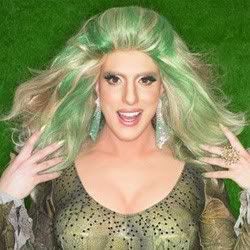
Hedda Lettuce Is Poly!


We crazy polyamorists love it when we can claim a celebrity -- what sexual minority doesn't? Poly NYC just sent out a mass e-mail because NYC drag queen Hedda Lettuce (the most environmentally friendly drag queen, or so I've heard) just came out as polyamorous on her blog.

Thursday, March 5, 2009

Prop 8 News

Well, it ain't good news... According to the New York Times the California Supreme Court justices seem ready to uphold Proposition 8, writing the gay marriage ban into the state constitution. The only sticking point is apparently the 18,000 marriages conducted before the ban went into effect. The court apprently doesn't think Prop 8 invalidates those marriages. Ken Starr and the homophobe brigade are scrambling for some kind of counter-argument that vaguely makes sense. Nothing so far.

Baby steps, baby steps...

Sunday, February 22, 2009

Podcast Round-Up: Week of 2/15/09

A little behind on podcasts but there were some good ones last week so here goes...

Savage Lovecast, ep. 121: In a special Valentine's Day episode, Dan talks to Wayne Bensen from Truth Wins Out about the lie of Christian "ex-gay" programs. And the Tech Savvy At Risk Youths' dreadlocks aren't getting any cleaner.

Sex Is Fun, ep. 162: Kidder, Laura, Coochie and Rick interview body waxer John Zeches after he removes all of the hair from Kidder's body. (I might have interviewed him before I got the full body treatment, but that's why Kidder is Kidder.)

Poly Weekly, ep. 192: Minx interviews BDSM and queer activist Clarisse Thorn about Sex +++, a pro-gay, pro-kink, pro-poly series of documentary screenings organized by Thorn in Chicago.

Wednesday, February 4, 2009

Sad News


The Oscar Wilde Bookshop on Christopher Street in Greenwich Village is closing due to the economic crisis. It's probably the oldest gay bookstore in America, having opened in 1967. A New York Times article gives you a little bit of the store's history, which is intertwined with the early days of the gay rights movement.

Wednesday, December 31, 2008

The Vault - Milk & The Times of Harvey Milk

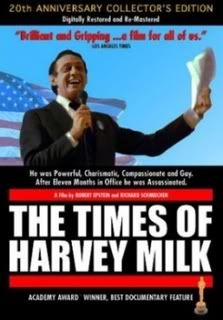
The Times of Harvey Milk (1984)
directed by Rob Epstein
starring: Harvey Milk, James Fierstein

Winner of the Academy Award for Best Documentary Feature in 1985, The Times of Harvey Milk uses archival footage and interviews to reconstruct the political career of the first openly gay elected official in the United States. The film briefly details Harvey Milk's campaign, his eleven month stint as a City Supervisor in San Francisco representing the new gay neighborhood in the Castro, his fight against Proposition 6 (a California ballot initiative that would have made it possible to fire all gay teachers and anyone who supported them) which gave Milk statewide and even national prominence, and his assassination by one of his colleagues, Supervisor Dan White, who also assassinated Mayor George Moscone. The final twenty minutes of the film follow White's trial, where his lawyer successfully convinced the jury that a combination of financial stress, family trouble and junk food caused White to become temporarily insane -- a travesty of justice that became known as "the Twinkie defense." White was convicted of manslaughter and served only six years in prison. He was released in 1984, the same year as the film (and committed suicide three years later, though that's not in the documentary).

On its artistic merits alone The Times of Harvey Milk is a pretty standard documentary: archival footage and audio supporting interviews with several of Harvey Milk's friends and political allies, all stitched together by James Fierstein's narration. But the filmmakers have done the one thing that every documentarian hopes to do -- they've found a story that is both fascinating on a human level and relevant in a larger social context.


Milk (2008)
directed by Gus Van Sant
written by Dustin Lance Black
starring: Sean Penn, Emile Hirsch, Josh Brolin, Diego Luna, James Franco

So, with such a wonderful, critically acclaimed documentary in fairly wide distribution, did director Gus Van Sant (My Own Private Idaho, Good Will Hunting, Elephant) need to give Harvey Milk the Hollywood treatment? Yes, I think he did. As we watched Sean Penn (as Milk) and his minions fight against Proposition 6, I doubt anyone in the audience could keep themselves from thinking of the recent battle against Prop. 8. That's a sure sign that the story of Harvey Milk needed to be told again, after 22 years. Sean Penn's performance is superb. Penn has clearly spent quite a bit of time looking at old video to get Harvey's mannerisms and voice right, but he gives his version of Milk something more than I saw in the documentary: a quiet vulnerability. Penn's Milk is fiercely determined, yes, but he's also a man who wears his heart on his sleeve no matter how much the birds peck at it. This touching performance rescues the film on the rare occasions when Van Sant and screenwriter Dustin Lance Black lay it on a little too strong -- such as the midnight phone call from the handicapped, suicidal gay teen or the attempt to turn Harvey's relationship with an ex (James Franco) into a romantic through-line even though it wants to be a close friendship.

Van Sant and Black aren't just trying to recreate the documentary with actors and that's what ultimately makes Milk a success. They use the historical events and a lot of the archival footage from the documentary as the skeleton of their film but then spend most of their time focusing on Milk himself. We see Milk as a Wall Street broker decide to come out of the closet and move to San Francisco. We see his humble entry into politics in the Castro, his three failed election campaigns, the suicide of someone close to him, and his role as a mentor to future AIDS activist Cleve Jones. The film also explores the motivations of Dan White in a way the documentary couldn't. Since we can only speculate about why he did what he did, the documentary could only follow the trial. Milk can show a fictional White (Josh Brolin) becoming more and more erratic, rejecting Harvey's attempts at friendship, and eventually surrendering to some personal demons which may, the film suggests without insisting, have included his own secret homosexuality.

Sean Penn's performance and Gus Van Sant's light touch make Milk one of the rare biopics that can actually stand on it's own as a good movie. But the experience of watching it will be vastly improved if you see The Times of Harvey Milk as well, and since the documentary is available for free at Hulu.com you really have no excuse not to, even if it isn't carried in your neighborhood Blockbuster.